The morning-rush playbook
How a self-order kiosk lets a small team handle a Saturday-morning rush without breaking service. The remake math, parallel-kiosk throughput, the elastic-pace effect of letting customers self-serve while staff helps the ones who want help, and how multi-kiosk fleets behave as one. Drawn from three peak summer seasons at Cafe Meria.
On a Saturday morning in peak season, a busy cafe lives or dies on a few minutes of throughput. The line forms before open. Tourists come in waves. Drinks are custom. Modifiers stack. The order at the register changes mid-sentence. Every minute of throughput counts, and every remake costs you double — first the time, then the trust.
Most cafes that haven’t solved the morning rush try to hire their way through it. Add a cashier. Add a barista. Stagger shifts earlier. It works, but only sometimes. The fundamental problem is that a counter station is serialised: the slowest customer at the front of the line sets the pace for everyone behind them. Adding a second cashier helps, but it doubles the labour line and only doubles the throughput if the kitchen can keep up.
A well-built kiosk solves the problem differently. Here’s what changes when the kiosk is on the counter — drawn from three peak summer seasons at Cafe Meria, the cafe in Charlevoix, Michigan where Order June was forged.
1. Remakes vanish because the order is the order
Verbal handoff is the silent rush-hour killer. The customer says “oat” and the cashier hears “almond.” The drink goes out. The customer comes back. The barista pulls the wrong drink off the rail and makes another one. Now the next four customers wait an extra ninety seconds.
Every cafe has a remake rate. Most owners don’t know what theirs is — but every barista feels it, every Saturday in July. At Cafe Meria, verbal remakes were the single biggest cause of mid-rush back-ups. The first weekend the kiosk replaced verbal handoff for morning custom drinks, the line moved noticeably faster — and the stress at the counter dropped.
The mechanism is simple. When the customer types their own order, the gap between “what they wanted” and “what got rung in” closes. There is no transcription. There is no ambient noise. There is no oat that gets heard as almond. The customer reads back their order before paying. If it’s wrong, it’s wrong because they tapped wrong — not because the cashier misheard.
2. The pace becomes elastic
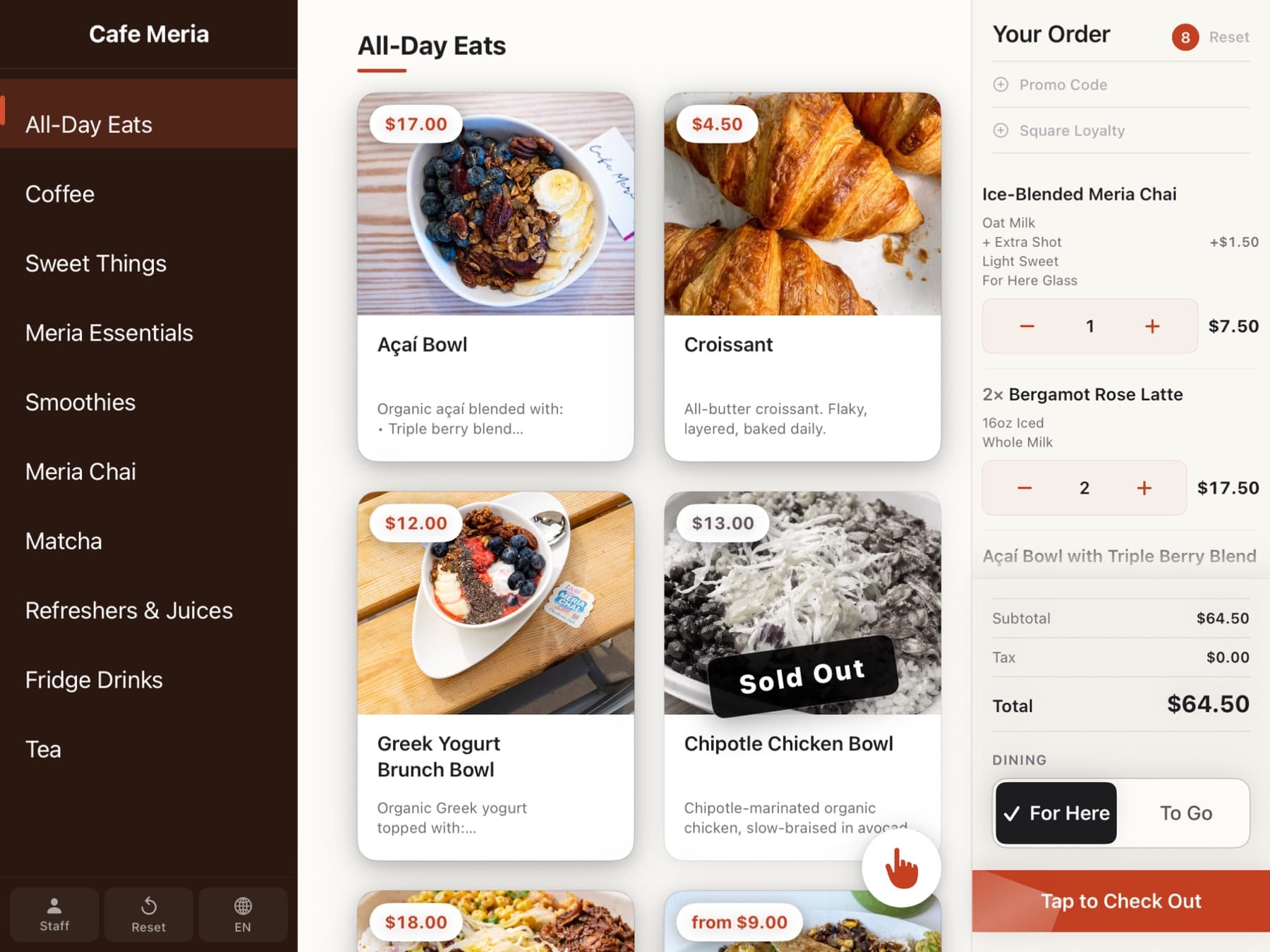
Here’s the part that surprised us most: once the kiosk was on the counter, most customers drove it themselves the second they touched it. They didn’t need help. They wanted to take their time, see the photos, pick the modifiers, type their note, pay.
For the customers who did want help — a first-time visitor, an older guest unfamiliar with kiosks, a tourist who wanted a recommendation — the team could still walk them through. We always offered. Both paths existed at the same time. The cashier could hand off to the kiosk for the regular who knew the order, and stay present for the first-time visitor who wanted a recommendation.
The pace became elastic. The same staff handled a much heavier rush because the customers who didn’t need help freed up the staff who could help the ones who did. On a busy morning, the team that used to feel pile-driven by the rush instead felt like they had range.
That’s the unsung benefit of a self-order kiosk: it converts service from a binary (cashiered or self-checkout) into a spectrum (everyone gets the level of attention they want).
3. The throughput math: parallelism
A counter-cashier transaction is paced by the slowest party. If the cashier is fast and the customer is slow, the cashier waits. If the cashier is slow, the customer waits. Either way, the line behind them stops moving.
A kiosk decouples the parties. Two kiosks running in parallel let two customers process at their own pace simultaneously. A first-time visitor reading the menu gets the time they need without holding up a regular who knows their order by heart. The math is straightforward: you replace one serialised station with N parallel ones, and N customers can move through at the speed of the slowest one of THEM rather than the speed of the slowest one in the whole line.
Most cafes that install a single kiosk see throughput rise roughly 20% in the morning rush. Cafes that install two see closer to 35%. The gain isn’t linear because the kitchen becomes the bottleneck — but the line at the counter, which is the customer-facing pain, evaporates. People don’t complain about a slow kitchen the way they complain about a slow line.
4. Multi-kiosk fleet behaviour: behave as one
A single kiosk is a useful tool. Two kiosks running independently is a problem. Two kiosks that share state — that’s a fleet.
Order June handles fleets natively. Atomic server-side order numbering means no two iPads ever ring up the same number, even when they fire orders in the same second. When staff mark a drink sold out in the admin, every kiosk in the room crosses it out within a second via Realtime. Broadcast pause and resume controls let you manage the whole fleet from your phone — useful when one Square Reader hangs, essential when a power strip pops.
Per-kiosk ticket templates and menu pinning make every kiosk its own configurable surface. Cafe Meria runs a named “Pink Portable” kiosk that travels between the counter and the patio depending on the day; the kitchen tickets print “from Pink Portable” in inverted bold so the team knows where the order originated. The counter kiosk runs the full menu; the patio kiosk runs a limited summer menu. Same software, different roles, same fleet.
When a kiosk gets weird — a printer cable comes loose, a Square Reader hangs, the iPad battery drops — the fleet view in the admin flags the kiosk red. The owner sees it from the floor on their phone, pauses the kiosk, fixes the issue, resumes. The other kiosks keep running while the affected one is offline. No customer hits a broken station.
5. The offline order queue: Wi-Fi flake doesn’t become a customer crisis
Tourist towns have hot Wi-Fi. Residential intersections have flaky cellular. A kiosk built around an always-on connection breaks at exactly the moment your throughput matters most.
Order June queues orders locally with idempotency keys when the network hiccups. The customer never sees a spinner. The kiosk completes the order against the local catalog cache, stores the queued payment, and prompts the customer for the next step (printed receipt, email, or no receipt). When connectivity returns, the queue drains. No duplicate orders. No lost orders. No awkward “can you tell me what you wanted again?” The customer never knows the network hiccupped.
Idempotency keys mean Order June can retry safely. Every CreateOrder + CreatePayment carries an idempotency key the kiosk holds locally. If the kiosk loses confirmation that Square received the order, it retries with the same key — Square deduplicates, the customer is charged once, the order shows up cleanly in the dashboard.
6. What rush-hour iteration looks like
Order June was developed against the Cafe Meria morning rush three summers in a row. Every UX decision was tested in production against real customers, real lines, real moments where a small detail compounded into a fifteen-second slowdown.
Some examples of what shifted because of the rush:
The persistent cart rail. Earlier versions transitioned to a checkout view when the customer hit a button. Customers lost their place; many backed out and started over; the second-time-through took 50% longer than the first. Persistent cart rail eliminated the transition.
The Hot/Iced color-coded segmented bar.A customer accidentally tapped “Hot” on what was supposed to be an iced matcha and walked out unhappy. The next morning we shipped a red-and-blue segmented control with full-width tap targets. The misorder simply cannot happen now.
The order-level dining toggle replaced a per-item one. The old per-item For Here / To Go selector added two extra taps to every line item. We replaced it with a single order-level toggle, plus a per-item override for mixed orders (the dine-in entrée plus the to-go cookie on the same ticket). Throughput rose immediately.
None of these changes came out of a designer’s whiteboard. Each was the answer to a real customer interaction that a cafe owner watched in real time during a real rush. That’s the kind of refinement most kiosk apps don’t get.
Where to start
If you run a cafe, restaurant, or food truck on Square and you’ve been carrying the morning rush on willpower — hiring more cashiers, staggering shifts earlier, watching the line back up despite your best efforts — Order June launches June 1, 2026 on the Apple App Store and Square’s App Marketplace. Get on the early-access list to be among the first businesses to install it.
Frequently asked
- What's the biggest source of rush-hour back-up in a typical cafe?
- Verbal-handoff remakes. The customer says one thing, the cashier hears another, the drink goes out, comes back, gets remade. Multiply by five drinks an hour and the line stops moving. When customers type their own orders, the gap between "what they wanted" and "what got rung in" closes — and the back-up disappears.
- Won't customers feel rushed by a kiosk?
- The opposite, when the kiosk is designed well. A persistent cart rail lets customers browse, reconsider, and adjust without losing their place. The pace is set by the customer, not by the line behind them. The result is calmer than a counter handoff, not more rushed.
- Does throughput really go up?
- Yes — typically 20–40% on the morning rush. The mechanism is parallelism: two kiosks process two customers at the same time. A first-time visitor reading the menu doesn't hold up a regular who knows their order. The bottleneck shifts from the counter to the kitchen, and a well-staffed kitchen can keep up.
- Do I need multiple kiosks to see the gain?
- Even one kiosk helps — especially against the verbal-handoff remake problem. But the parallelism advantage shows up clearly with two. A patio kiosk and a counter kiosk together can run a busy morning that a single counter cashier would struggle with.
- What about staff — do I lay people off?
- No. In every cafe we've watched, the team shifts from cashiering to making drinks, running food, or starting the next bar. Total labour stays similar; throughput rises. Cashiering shifts from a serialised station to elastic helping — the team supports the customers who want help and lets the rest self-serve.
- What happens if the Wi-Fi drops mid-rush?
- Order June queues orders locally with idempotency keys. The customer never sees a spinner of doom; the order completes against the local cache. When connectivity returns, the queue drains and orders sync to Square. No duplicates, no lost orders, no awkward "can you tell me what you wanted again?"
- How do multi-kiosk fleets handle order numbering?
- Atomic server-side. Every kiosk asks the same Postgres sequence for its next order number, atomically. No collisions. Tickets are unique across the entire fleet, even when five iPads ring up an order in the same second. Per-kiosk ticket templates label every kitchen ticket with its origin.
- What's the most useful operational signal during a rush?
- The fleet view in the web admin. You see every kiosk's live status, the current queue depth, and the last heartbeat. When something hangs (a Square Reader, a printer, a pairing), the affected kiosk shows up red — pause the kiosk from your phone, walk over, fix the issue, resume. Most software hides this; we put it on the dashboard.
Built for the morning rush.
Launching June 1, 2026 on the Apple App Store and Square’s App Marketplace. Drop your email and we’ll send eight short notes between now and launch — one per part of the product.